
One Air
System
The One Air System combines liquid-desiccant dehumidification technology with a refrigerant cycle to achieve high-efficiency moisture removal and simultaneous cooling.
Built differently.
Performs exceptionally.
Four core innovations that separate the One Air System from conventional dehumidification technology.
One Air collects waste heat from the compressor to increase dehumidification efficiency, saving up to 87% energy.
All-in-one system that dehumidifies and cools the air for proper climate control in every space.
In a 3-week test, One Air achieved zero bacteria and mold build-up compared to conventional systems with 300 bacteria and 59 mold count.
One Air can dehumidify the air below the 0°C dew point and has a wide range of installation options to fit various environments.
Operating Principle
A continuous two-unit cycle that absorbs, regenerates, and recirculates — with no downtime and no defrost.
The One Air System consists of a dehumidification unit and a regeneration unit. These components operate continuously in real time to precisely control the air's temperature and humidity.
During operation, processed air enters the unit and contacts the solution, allowing moisture and heat to be absorbed. The moisture-laden solution transfers to the regeneration unit while outdoor air passes through a pre-filter to remove dust and particulate contaminants.
The outdoor air absorbs moisture and heat from the diluted solution and is discharged outside. The solution is restored to a high-concentration state and reused immediately — no downtime.
- AbsorberMoisture and heat absorption from processed air
- RegeneratorSolution restored via heat exchange with outdoor air
- Compressor & Electrical ComponentsRefrigerant cycle powering the system
- Regeneration FanExhausts processed regeneration air outside

Why is Dehumidification Important?
In tropical climates, humidity is the hidden driver of energy waste, health risk, and industrial loss.
In Southeast Asia, air temperature alone is a poor indicator of how the human body actually experiences its environment. Relative humidity is equally critical. As humidity rises, the body's ability to cool itself through perspiration diminishes, causing the perceived temperature to feel significantly higher than the measured air temperature. In tropical climates where humidity routinely exceeds 70%, the gap between measured and perceived temperature can reach 3–5°C, with direct consequences for comfort, productivity, and health.
Lowering humidity levels requires more energy than reducing temperature. Efficient moisture removal is key to reducing overall energy consumption.
Industry Challenges
In sectors like food, pharmaceuticals, semiconductors, and chemicals, improper humidity control can lead to:
- Bacterial and mold growth
- Product corrosion
- Clumping of powders
- Compromised product quality
- Costly downtime
At 60% RH, a room set to 26°C feels like 27°C. Perspiration is inhibited — the body cannot cool itself efficiently.
At 40% RH, a room at 28°C also feels like 27°C. Lower humidity allows natural perspiration — same comfort, less energy.
Traditional vs Tropical
Why the 25°C standard was designed for Europe — and why it fails in Southeast Asia.
ASEAN tropical climate outdoor temperatures (33–36°C) and RH (70–90%) create a wide temperature and humidity gap with indoor air, causing condensation when cooler surfaces meet hot and humid air. The traditionally recommended 25°C indoor temperature works well in colder areas (Europe and East Asia) but is inefficient in Southeast Asia.
By maintaining 28°C, the indoor-outdoor gap can be closed, stabilizing conditions and reducing the dew point to safe levels approaching 0°C — eliminating condensation risk.
ASEAN Region — Relative Humidity
Feb 26, 2026 · 9:00 AM · Source: Zoom Earth
Space Cooling & Perceived Temperature
How humidity shifts perceived temperature — and where the 28°C / 40% RH sweet spot sits.
| RH / Temp | 25°C | 26°C | 27°C | 28°C | 29°C | 30°C |
|---|---|---|---|---|---|---|
| 25% | 22.2 | 23.1 | 24.0 | 24.9 | 25.8 | 26.7 |
| 30% | 22.8 | 23.7 | 24.6 | 25.5 | 26.5 | 27.4 |
| 35% | 23.3 | 24.2 | 25.2 | 26.1 | 27.1 | 28.0 |
| 40% | 23.8 | 24.7 | 25.7 | 26.6 | 27.6 | 28.5 |
| 45% | 24.2 | 25.2 | 26.1 | 27.1 | 28.1 | 29.0 |
| 50% | 24.6 | 25.6 | 26.6 | 27.6 | 28.6 | 29.5 |
| 55% | 25.1 | 26.0 | 27.0 | 28.0 | 29.0 | 30.0 |
| 60% | 25.5 | 26.5 | 27.5 | 28.5 | 29.4 | 30.4 |
*Difference in perceived temperature due to humidity
Research proves that occupant comfort in tropical climates is more strongly correlated with humidity control than temperature alone. Maintaining indoor RH within 40–60% reduces perceived temperature by 2–4°C, allowing thermostat set points to be raised — cutting energy consumption by an estimated 10–20%.
Fatigue, sore throat, headaches, and respiratory irritation triggered when indoor AC creates conditions the body cannot adapt to. In Southeast Asia, most AC units set to 18–22°C create a 10–17°C indoor-outdoor differential — beyond the 7–8°C threshold recommended by WHO and ASHRAE.
Maintains 40–60% RH to reduce perceived temperature by 2–4°C. Narrows the indoor-outdoor differential to within safe thresholds, cuts energy use by 10–20%, and eliminates bacteria, mold, and airborne pathogens — verified by third-party laboratory testing.
Air Quality Performance
Independent lab testing across bacteria, mold, and noxious gas reduction.
Korea Testing Laboratory (KTL) · Standard: KOUVA AS 02:2019
| Configuration | Bacteria Reduction |
|---|---|
| With filter | 99.90% |
| Without filter | 96.90% |
| Gas | Reduction | Flow Rate |
|---|---|---|
| Ammonia | 99.40% | 2.04 m³/min |
| Toluene | 50.10% | 0.28 m³/min |
| Formaldehyde | 72.30% | 0.51 m³/min |
Dept. of Agriculture – Food Development Center PH · CFU/m³
| System | Return | Supply | Result |
|---|---|---|---|
| One Air System | 2,050 | 700 | −65.9% |
| Conventional | 3,950 | 4,550 | +15.2% |
Dept. of Agriculture – Food Development Center PH
| System | Return | Supply | Result |
|---|---|---|---|
| One Air System | 750 | 100 | −86.7% |
| Conventional | 1,700 | 1,725 | +1.5% |
Industrial Dehumidification Systems
How One Air compares against conventional and desiccant rotor systems on every meaningful metric.
Accurate and consistent humidity management.
Compact, lightweight design for rapid deployment.
Flexible expansion without excessive energy consumption.
Lower operating costs without additional cooling.
Despite different moisture-removal mechanisms, both conventional systems require a dedicated cooling stage downstream — leading to higher operating costs and significant energy waste.


*Values are for demonstration and explanation purposes only.
The One Air System is engineered to bypass the unnecessary cooling stage in conventional systems — the reason it is cost-effective with a high energy-saving rating.
| Specification | Conventional | Desiccant Rotor | One Air System |
|---|---|---|---|
| Capacity | 5 kg/h | 5 kg/h | 5 kg/h |
| Power Consumption | 2–3.5 kW | 6–8 kW | 1.53 kW |
| Efficiency | 1.4–2.5 kg/kW | 0.6–0.8 kg/kW | 3.28 kg/kW |
| Additional Cooling | Required | Required | Included |
| Voltage | 220V 1-ph | 380V 3-ph | 220V 1-ph |
| Below 0°C Dew Point | No | No | Yes |
| Defrost Cycle | Required | Required | None |
| Bacteria & Mold | High | Moderate | Zero (verified) |
| Scalability | Separate units | Separate units | All-in-one |
Wide Range of Humidity Control
From 0°C to 30°C, 30% to 60% RH — continuous operation with no defrost cycle.
Performance Test Results
Dehumidification capacity under various indoor and outdoor temperature and humidity conditions.
Test Conditions
| Cond. | Indoor | Outdoor | ||
|---|---|---|---|---|
| Dry-bulb | Wet-bulb | Dry-bulb | Wet-bulb | |
| A | 27.0 ± 1.0°C | 21.2 ± 0.5°C | 27.0 ± 1.0°C | 21.2 ± 5.0°C |
| B | 27.0 ± 1.0°C | 21.2 ± 0.5°C | 35.0 ± 1.0°C | 24.0 ± 5.0°C |
| Test Item | Unit | Cond. A | Cond. B |
|---|---|---|---|
| Dehumidification Capacity | kg/h | 5.76 | 5.43 |
| Power Consumption | Wh | 1,757.6 | 1,810.4 |
| Efficiency | kg/kW | 3.28 | 3.00 |
It can dehumidify space or air from 0°C to 30°C — giving a better option to control humidity in spaces required to meet HACCP standards.
The system is optimized to control humidity between 30% RH and 60% RH at all temperatures. One Air dehumidifies continuously below the 0°C dew point without defrost cycles, enabling precise humidity control and energy savings in cold-chain facilities.

| Condition | Capacity | |
|---|---|---|
| Temperature | Humidity | |
| 27°C | 78% | 7 kg/h |
| 60% | 5.56 kg/h | |
| 24°C | 60% | 4.5 kg/h |
Product Specifications
Complete technical specifications, performance data, and dimensional drawings for the One Air System.

Full Specifications
| Technology | Hybrid Liquid Desiccant |
| Dehumidification Capacity | 5.19 kg/h |
| Dehumidification Efficiency | 3.28 kg/kW |
| Cooling Capacity | 6 kW |
| Refrigerant | R-410A |
| Dimensions (W × D × H) | 990 × 460 (485) × 2,190 mm |
| Weight | 220 kg |
| Voltage / Frequency | 220 V / 60 Hz |
| System Power | 1,700 W (Max. 2,200 W) |
| Protection Rating | IP33 |
| Temperature Range | 0°C – 30°C |
| Humidity Range | 30% – 60% RH |
*Test conditions: 27°C, 60% RH · Figures may vary depending on site conditions.
Processing Unit
Regeneration Unit
Dimensions
Compact. Efficient. Smart.
The One Air System adapts to your needs.
3 Installation Position Suggestions
Operates independently for immediate humidity control across various spaces. Suitable for small spaces or specific environments.
Integrated with existing HVAC (AHU) to simultaneously supply dry air to multiple zones. Highly scalable with central control.
Installed outside the protected space to pre-dry air before it enters. Effective even in space-constrained environments.
Stand-alone Type
Operates independently without the need for other systems, providing flexible, localized climate control for smaller or specialized spaces.
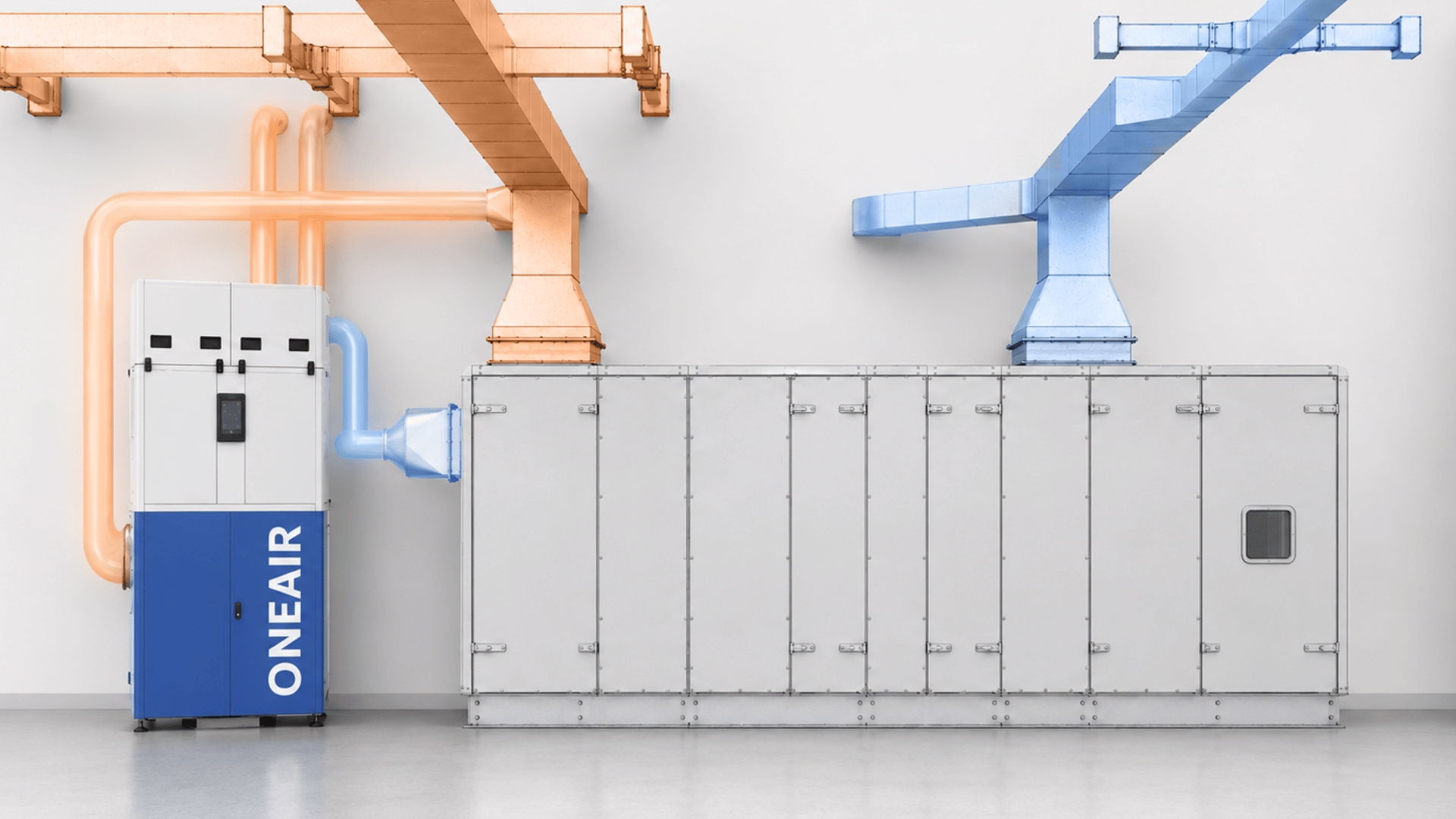
AHU Connected Type
Integrates into the existing Air Handling Unit (AHU), delivering consistent air quality and increasing dehumidification capacity across large facilities.
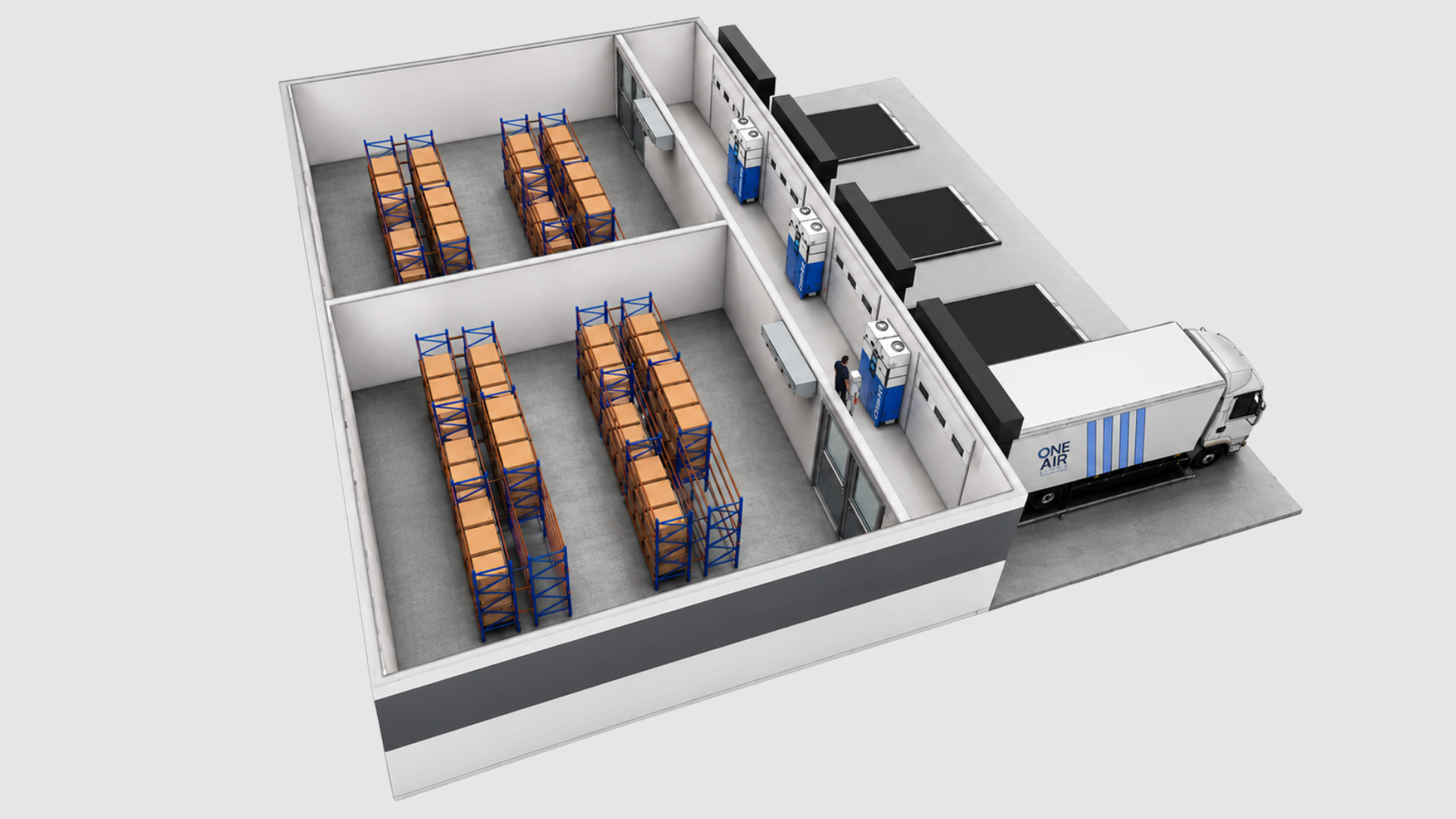
Adjacent / Transfer Zone Type
Installed outside the protected space to pre-dry incoming air before it enters. Effective even in space-constrained environments where internal installation is not possible.
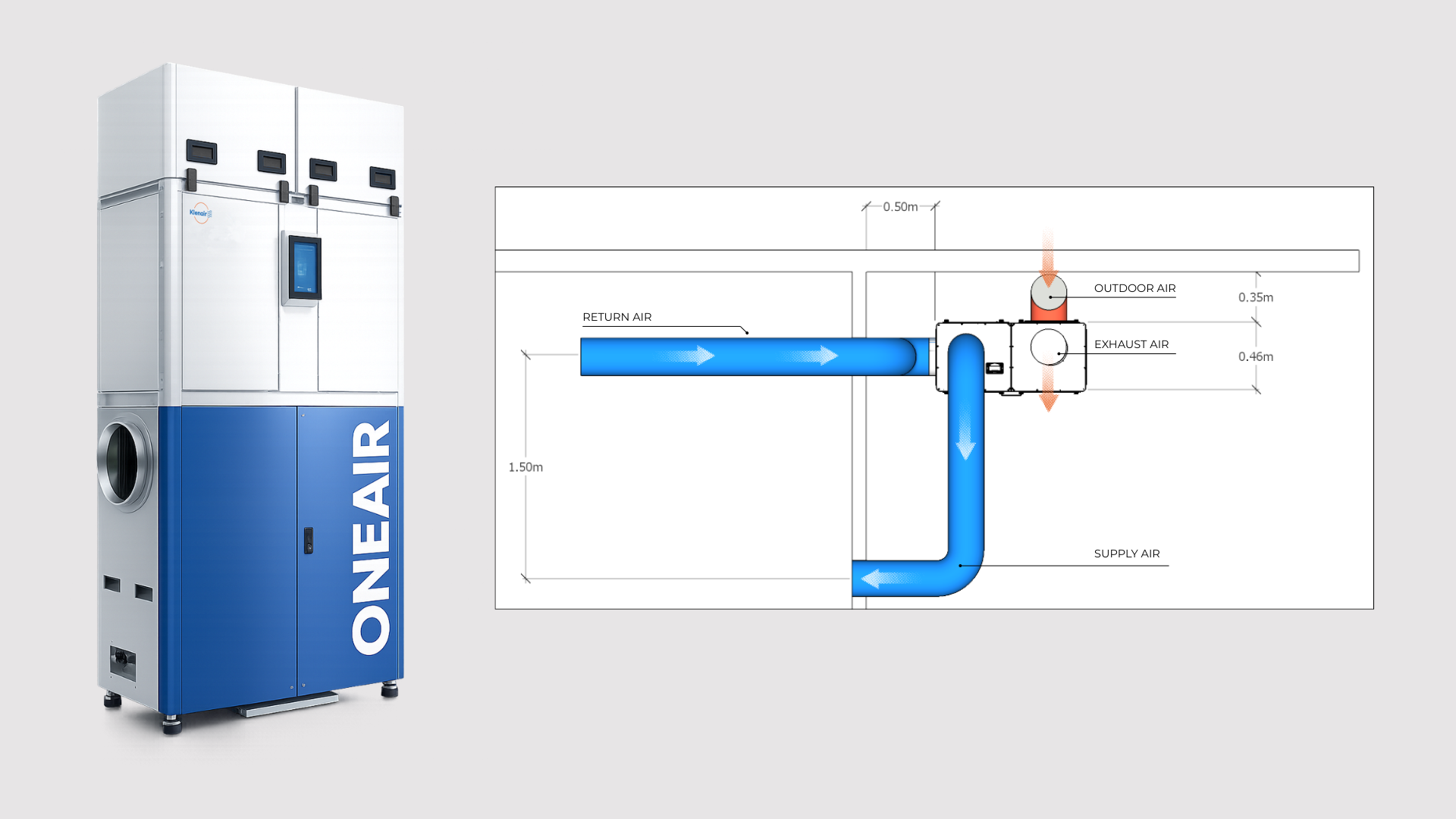
Typical Ducting Layout
The diagram illustrates the typical ducting layout for the unit, showing how air flows through each duct connection. Layout and configuration may vary depending on the installation environment. *Exhaust duct is required.

Industrial Applications
Proven across industries where humidity control directly impacts product quality, safety, and compliance.
Protects goods from moisture damage
Ensures stable production conditions
Maintains hygiene and prevents spoilage
Protects components from corrosion
Stabilizes air conditions for safe handling
Prevents rust and humidity damage
Protects crops and stored food from humidity
Maintains product quality during processing
Prevents warping and spoilage of products
Creates comfortable, healthy environments
Ensures reliability in production and storage
Preserves valuable collections and artifacts
Are the conditions in your facility too extreme?
The One Air System is customizable for your facility. Let us know about the situation.